Industry
How to Study Award Speeches as Live Performances
Award speeches are live performances shaped by movement, nerves, and time pressure. Learn how to study their delivery, structure, transcripts, and footage.
The acceptance speech is the shortest form in public speaking, delivered to the largest audiences, with the least preparation, by people who are not speakers by trade and who have just had a shock.
Almost everything strange about the genre follows from those four facts at once. It deserves study rather than anecdotes, because the constraints are so extreme that they make visible what gentler forms hide.
What to take away
- The time limit is the defining constraint of the form, and it can be planned for.
- Ask most people about award speeches and they will describe disasters.
The physical conditions
These matter more here than anywhere else, because there is no time to recover
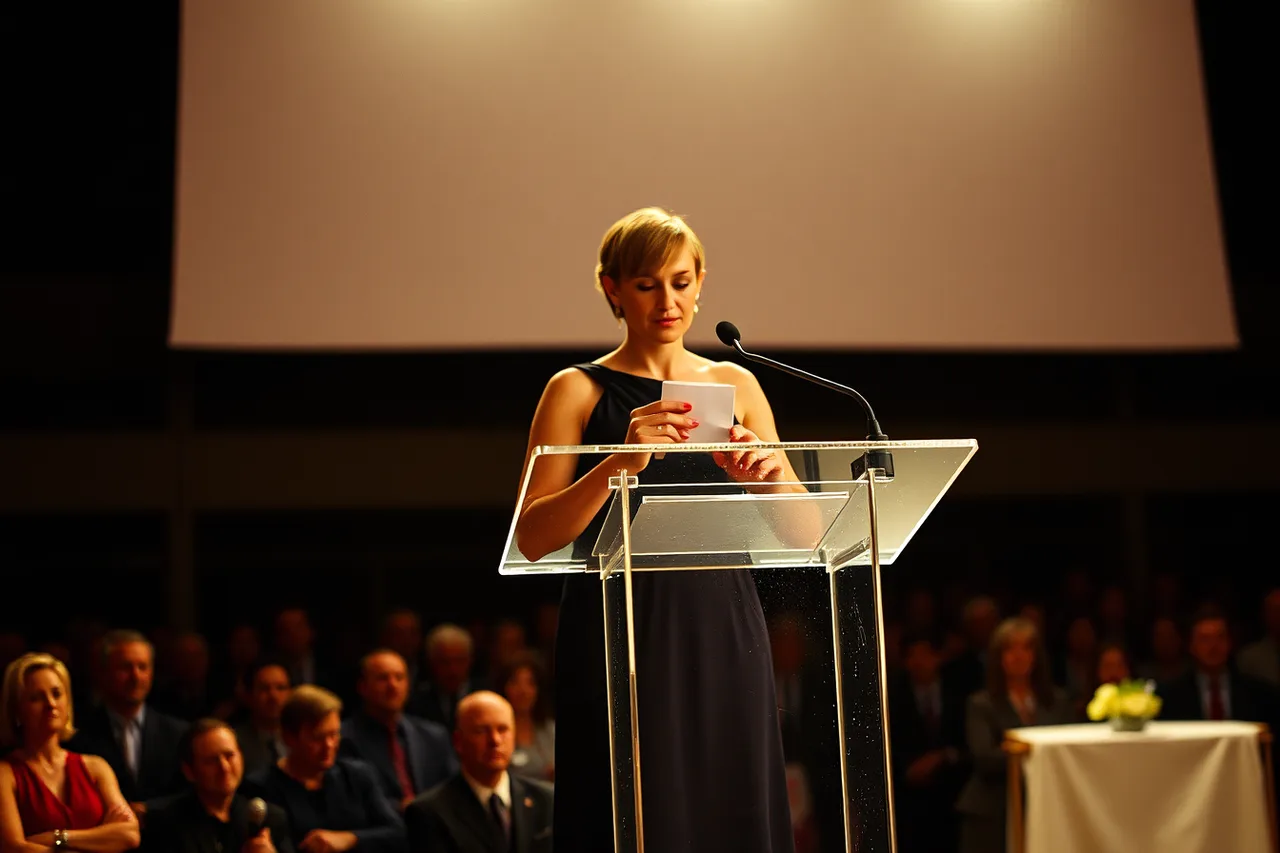
The speaker has usually just learned they won. Adrenaline arrives within seconds and does specific, predictable things: shallow breathing, a faster speaking rate, hands that shake enough to make reading from a card difficult, and a narrowing of attention that makes recall of prepared material unreliable.
They walk some distance while the room applauds, which means they arrive short of breath and with no chance to settle. They have not stood at that lectern before. The lighting usually prevents them from seeing much of the audience.
Jennifer Lawrence's 2013 Academy Awards acceptance speech offers a concrete case to study. After falling on the stairs on her way to accept the Best Actress award for Silver Linings Playbook, she referred to the fall in her opening remarks; the recording lets viewers examine the walk, recovery, and audience response without treating any visible sign as proof of adrenaline.
In televised ceremonies, a cutoff is often signaled by play-off music rather than a spoken warning. At the Academy Awards, orchestra music serves as that cue, leaving the speaker to decide how to end without a verbal signal.
Any analysis that ignores this and treats the result as a considered composition is analyzing something that did not happen.
The list of thanks is not filler
Outsiders reliably misjudge this part. Naming collaborators looks like padding, and it is the professional core of the form.
In most award-giving industries, a public credit is real currency. A ceremony mention is a career fact for people whose work is otherwise invisible.
An omission is noticed by the person omitted, by colleagues, and sometimes by whoever hires them next. Speakers know it, so they put the list ahead of saying anything interesting, then agonize over the gaps.
This has structural consequences. Names resist compression, since you cannot half-thank someone, so the list is nearly fixed in length and everything else must fit around it.
Order carries meaning, so it cannot be shuffled to improve flow. A speaker anxious about forgetting somebody delivers the list fast and early, which is why many of these speeches front-load their least interesting material.
The collision at the center of the form
Two things compete for the same limited time.
The ritual wants the thanks, the acknowledgment of the award-giving body, and the expression of gratitude. It is a ceremony and the speech is a component of it.
Occasionally a speaker uses the platform for something else: an argument, a protest, a dedication, a piece of news. The platform is unusually powerful for exactly that, because the audience is enormous, unfiltered, and cannot look away.
The second kind gets remembered, and it is riskier than it looks because it competes with the ritual for the only time available. A speaker doing that briefly works in the mode set out in political speeches, where the object is to produce a decision in somebody else.
The available time is not enough to do that properly.
When it works it tends to share a shape: it happens fast, it is specific rather than general, it does not argue a case that needs evidence, and it finishes before the music. When it fails, the speaker usually tried to do both jobs properly and ran out of time in the middle of the second.
Designing for a hard cut
The time limit is the defining constraint of the form, and it can be planned for.
Know the first sentence and the last sentence exactly. These are the two that adrenaline is least likely to take away, and the last one is what determines whether the ending sounds like an ending or like an interruption.
Fix the order of names in advance and do not improvise it. Reordering under stress is where people lose their place.
Include nothing that requires setup. A joke that needs a premise, a story that needs a scene, or a point that needs a concession first will not survive the cut, and being cut mid-construction is worse than not starting.
Assume you will be cut. Build so that being stopped anywhere after the first thirty seconds still leaves a complete-sounding speech behind. This is the single most practical thing in the genre and almost nobody does it.
Say the non-ritual thing early if you are going to say it. The ritual can be compressed in the last few seconds. An argument cannot.
Why the genre is remembered as a series of failures
Ask most people about award speeches and they will describe disasters. That impression is an artifact of what circulates.
A competent acceptance speech is unmemorable by design: it does its ritual job, stays inside its time, and vanishes. An awkward one, an overrunning one, or an unexpected one is clipped, shared, and replayed for years. The visible sample is therefore almost entirely composed of the anomalies.
Anyone analyzing the form should correct for this deliberately, by working from a complete set of speeches from one ceremony rather than from the clips that survived. The picture changes considerably. The same correction applies to any ceremony with a fixed running order, including the material in commencement speeches, where a whole morning of speaking survives as one extract.
The primary document is audio-visual
This genre has an unusual documentary situation. There is often no manuscript at all: nothing was written down, or what was written was a list of names on a folded card that no longer exists.
That means the "text" of an award speech is almost always a transcript made afterwards from a broadcast. Several things follow, and they matter for anyone quoting one:
| Feature of the speech | What a transcript does to it |
|---|---|
| Pauses and hesitation | Removed, or standardized into commas |
| Sentence boundaries | Invented by the transcriber; speakers under stress do not speak in sentences |
| Overlapping applause and music | Usually deleted, along with any indication of where it began |
| Emotion, breaks in the voice | Absent entirely, or reduced to a bracketed note |
| An interrupted ending | Often tidied into a complete sentence |
| Ad-libs and false starts | Frequently cleaned up |
A transcript of an acceptance speech is therefore an interpretation, and different transcripts of the same speech will differ. That is a property of transcription generally rather than a defect of any particular transcriber. If you are working on one, cite the recording and the timing rather than a text, and say who produced any transcript you rely on.
What "a good one" would even mean
"Memorable" is a bad criterion, for the reasons above. Some better ones, which have the advantage of being checkable:
What a good one would even mean
- Did it complete the ritual?Were the obligations met: the body thanked, the necessary people named?
- Was it audible and followable?Under adrenaline, plenty of these are neither.
- Did it hold the room?Audience audio is imperfect evidence, but a room that goes quiet is doing something different from a room that keeps rustling.
- Did it survive the cut?Whether the speech was still complete at the point it was stopped.
- Did it cost anyone anything?Omissions, a claim the speaker had to walk back, or an attribution the speaker got wrong in front of a large audience.
Judged this way, the genre looks quite different from how the clip reel presents it.
Rights, and why clips prove nothing
Ceremony footage is normally produced and owned by a broadcaster or a production company under an arrangement with the award-giving organization. That footage carries its own rights, held separately from anything the speaker might have in their words, and it is generally licensed commercially.
The words and the footage are separate works with separate owners, which is the first thing the Copyright Office's summary of copyright in general makes clear. Clips circulating widely online tell you nothing about permission. Availability is not a status determination, and heavy circulation is if anything a sign that enforcing is worth someone's while.
If you intend to use footage, go to the broadcaster's licensing arm or the organization's press office. The answer for the video may differ from the answer for the audio or a transcript. The general method for working this out rather than assuming it is in public domain speeches.
How to study one
- Watch it once with the sound off.Posture, the walk, what the hands do, where the eyes go. In this genre body language carries an unusual share of the information, because the speaker is not in control of it.
- Then listen without the picture.Pace, breath, and whether the voice is under control. The two passes disagree more often than you would expect.
- Time everything.Total length, time to the first substantive sentence, time spent on names, time between the music starting and the last word.
- Count the names, and note whether they are role-identified or bare.
- Mark where the audience noise changes.Not the volume of applause, which is mixed for broadcast, but the moments the room's sound changes character.
- Note the ending.Whether the speaker finished, was cut, or manufactured an ending on the spot when the music started. That last case is where the genre's real skill shows.
Put the method to work on named examples from more than one ceremony:
- Jennifer Lawrence's Best Actress acceptance for Silver Linings Playbook at the Academy Awards: follow the fall, recovery, and audience response.
- Sally Field's Best Actress acceptance for Places in the Heart at the Academy Awards: compare the recording with the line often misremembered from it.
- Halle Berry's Best Actress acceptance for Monster's Ball at the Academy Awards: consider the speech's place in the category's history; Berry was the first Black woman to win it.
- Sacheen Littlefeather's appearance on Marlon Brando's behalf at the Academy Awards: examine how a protest meets the ceremony's ritual.
- Meryl Streep's Cecil B. DeMille Award speech at the Golden Globes: mark the turn from thanks to public criticism.
Use the full available ceremony segment where possible, then run the checks above; a circulating clip can conceal what came before and after the excerpt.
Related: business speeches for the other form where the speaker's relationship with the room distorts every signal, and war and peace speeches for occasions where brevity is imposed by obligation rather than by a clock.
Common questions
How long is an acceptance speech supposed to be?
There is no single length across award-giving bodies or editions. At the Academy Awards, the orchestra play-off music is the practical cue described above; check the Academy of Motion Picture Arts and Sciences for the applicable guidance for the edition you are studying.
Is there ever a written text?
Sometimes a card with names on it, rarely anything more. Treat the absence of a manuscript as normal in this genre, and treat any circulating text as a transcript somebody made afterwards.
Why do speakers thank so many people?
Because a public credit is a working currency in most award-giving industries, and an omission is noticed by the person omitted. It is the professional part of the speech, not the padding.
Can I tell from a clip whether the speaker was cut off?
Not reliably. A clip has been trimmed by an editor, so a clean ending may be the editor's. Look for the full segment, and for the music cue, before concluding anything about the ending.
What should I cite when writing about one?
The recording, with the holding body and a timecode, plus a note of who produced any transcript you used. A citation reading "in his acceptance speech" tells a reader nothing they can check.
In this guide
- How to assess lists of best award speechesA framework for judging lists of best award speeches: separate emotional impact, humor, consequence, and craft, then state their criteria and selection process.
- Getting short award speeches right the first timeShort award speeches take shape under a real clock: Patty Duke’s Oscar example, the Academy’s 45-second limit, three structures, and how to read interruption.
- Checking an award speech quote: the four claims worth confirmingAward speeches source check: the four claims inside a ceremony quotation, where recordings and programs are held, and how to report what you cannot find.
- Award speeches context: weighing press and broadcast recordsAward speeches context from the record of the night: how to weigh trade reports, next-day coverage, broadcast logs and recordings, and what each can fix.
- Which award speeches are most often misquotedSeven award speeches carry the most misquotes, from Sally Field in 1985 to Meryl Streep in 2017, and each famous Oscar moment has a checkable fix.
- How award speeches changed decade by decadeAward speeches by decade trace radio's first live ceremonies to the clip era, with archive sources and transcript collections that let you check each shift.