
Costs
Why commencement speeches face the worst listening conditions
Commencement speeches face the worst listening conditions in public speaking. The moves behind Jobs at Stanford and Wallace at Kenyon, and how to study one.
Nobody in the crowd came to hear you.
This is the founding condition of commencement speeches, and most discussions skip it. The audience gathered for a ceremony about somebody else's achievement.
The speaker is an item in the running order, placed between processional music and the reading of several hundred names. This form is speech delivered to people waiting for something other than the speech.
Everything characteristic about the genre, its formulas, self-deprecation, compulsory list of instructions, and send-off, responds to that condition. Once you see the constraints, the conventions stop looking lazy and start looking like solutions.
That also shows why they fail when copied by someone who has not thought about the constraints at all.
What to take away
- The best-known examplesSteve Jobs at Stanford in 2005, David Foster Wallace at Kenyon in 2005, J.K. Rowling at Harvard in 2008, George Saunders at Syracuse in 2013 — are built from the same small set of moves.
- Each move answers a condition of the roomoutdoor noise, a long ceremony, three audiences, and no way for the audience to answer back.
- Graduation addresses have an unusual afterlife as printed texts, and the printed text is rarely the delivered one.
The listening conditions
These are the worst conditions in any common speech genre, and they deserve
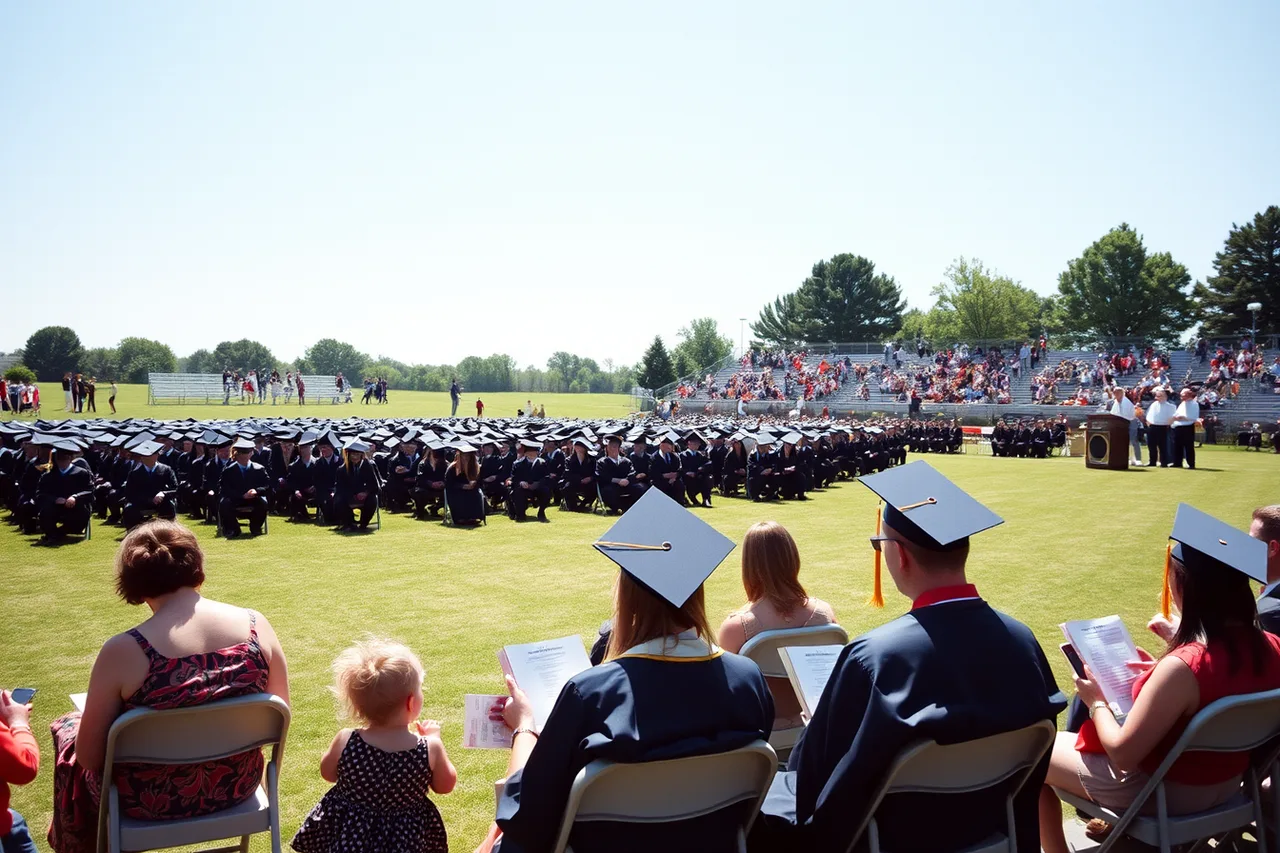
- Often outdoors, with sun, wind, or rain, and amplification designed for announcing names rather than carrying nuance.
- Long duration.The audience has usually been seated for a while and knows it will be seated for a long time afterwards.
- Physical discomfort.Folding chairs, academic dress in warm weather, families with small children, people who traveled that morning.
- Divided attention.Graduates are looking for their families; families are looking for their graduate; a large fraction of both groups are holding phones.
- No possibility of response.The audience cannot ask anything, and applause is scheduled by convention rather than earned.
- A fixed slot.Overrunning delays the part everybody actually came for, and the room knows it.
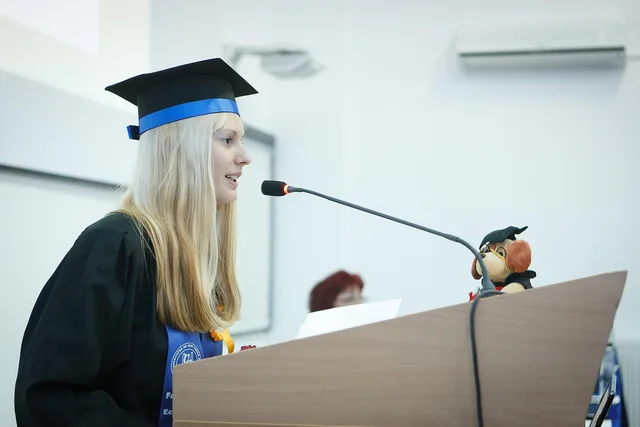
A speech that ignores all of this can still be a good text. It will not be a good speech, because a speech is an event in a room and not a document. The only common form with worse acoustics is the outdoor mass meeting, and the way speakers solved that problem is set out in civil rights speeches. Two of the most quoted addresses of the form, Steve Jobs at Stanford in 2005 and J.K. Rowling at Harvard in 2008, were delivered outdoors to enormous crowds, and a lecture hall, a courtroom closing argument, or a sermon in a church gives a speaker far more control over the room than that.
Three audiences who want different things
The graduates want it to be short, to acknowledge what they have just finished, and not to be condescended to. Many are exhausted, some are anxious about what happens next, and very few want to be given a life plan by a stranger.
The families want reassurance that the years and the money produced something. They are more receptive than the graduates, more likely to be moved, and more likely to remember the speech.
The institution wants dignity, no controversy, and a speech that reflects well on it. It usually has views about length and about subject matter, and it has invited the speaker for reasons of its own.
These three sets of preferences conflict, which is why the genre converges on a narrow band. Speaking to several audiences at once, each hearing a different speech, is the standing problem of political speeches. The solutions are much the same.
A speech that fully satisfies the graduates often disappoints the families, while one that satisfies the institution rarely surprises anyone.
The recurring moves, and what each one solves
Read enough of these and the same structural moves appear. They are worth naming, because each is a solution to one of the constraints above.
The disclaimer about advice. The speaker begins by acknowledging that nobody remembers these speeches, or that they are unqualified to advise anyone. This lowers the stakes and buys goodwill from an audience braced for a lecture. It works exactly once per speech and it is now so standard that it can be heard coming. Steve Jobs opened his 2005 Stanford address this way: "I never graduated from college. Truth be told, this is the closest I've ever gotten to a college graduation."
The story of a failure. A personal setback, told in some detail, usually from early in the speaker's career. It solves the credibility problem: a successful person addressing people with no prospects yet: by putting the speaker back at the audience's starting position. J.K. Rowling built her 2008 Harvard address around "the fringe benefits of failure," and it is the clearest case of the move.
The reversal. "Here is what you will be told, and here is why it is wrong." This solves the attention problem, because a contradiction is one of the few things a restless audience will orient toward. David Foster Wallace's 2005 Kenyon address is the textbook case: it opens with the parable of two young fish who do not know what water is, and it turns the expected celebration of a degree into an argument about attention.
The instruction set. Two, three, or four things to do. It gives the audience a countable structure they can follow without concentrating, which matters enormously in bad listening conditions. George Saunders's 2013 Syracuse address reduces the whole form to a single instruction — to err in the direction of kindness — and is remembered for it.
The send-off. A direct address to the graduates in the final movement, usually shorter sentences, usually a shift into the second person. It signals the end audibly, which the applause depends on. Steve Jobs closed his 2005 Stanford address with a line he credited to the final issue of the Whole Earth Catalog: "Stay hungry. Stay foolish."
None of these is a cliche in itself. They became conventions because they work against real difficulties. They read as cliches when a speaker uses them without the difficulty: the failure story with no failure in it, the instruction set with nothing specific to instruct.
The advice paradox
Institutions invite speakers because they are unusual: they did something few people do. Then they ask them to give advice that applies to everyone.
The route that produced the speaker is, by definition, not a route the audience can follow. It depended on a period, a set of accidents, and often on circumstances that no longer exist. A speaker who ignores this delivers universal instructions derived from an unrepeatable case, which is the central weakness of the whole genre.
The speeches that escape it do one of three things:
- They narrow to the speaker's own conditionsand describe them honestly, letting the audience extract what applies. J.K. Rowling's 2008 Harvard address does this with the years of failure that came before her writing.
- They address something other than the audience's careeran argument, an idea, a piece of the world. David Foster Wallace's 2005 Kenyon address is the standard example; it is about attention and what you choose to pay it to.
- They concede the paradox openlyand say the smaller, more defensible thing they actually believe. George Saunders's 2013 Syracuse address does exactly this with one instruction: to err in the direction of kindness.
Specificity is the mechanism in all three cases. A precise account of one person's circumstances is more useful to a listener than a general rule, because the listener can compare it to their own. A general rule cannot be compared to anything.
The one genre with a second life as text
Graduation addresses have an unusual afterlife. They appear in programs, alumni publications, and books, and circulate as text more reliably than most spoken forms. Two of the best-known became books: David Foster Wallace's Kenyon address was published as This Is Water, and George Saunders's Syracuse address as Congratulations, by the Way.
The ceremony is old, and its conventions are remarkably stable, as the long history of graduation shows. The printed afterlife is a modern addition. For many people, the encounter with a famous one is entirely on the page.
This has consequences the speaker should know about in advance.
The speech is written for two channels. What carries in a field: repetition, short clauses, direct address: reads as thin on paper. What reads well on paper is frequently unhearable outdoors. Most speakers pick one; the good ones pick the room, because that is the audience that is actually present.
The printed version may not be the delivered version. Institutions publish prepared texts. Speakers cut on the day, add things, lose their place, respond to the weather. Anyone comparing a published text to a recording will usually find differences, and neither document is the "real" one: they are records of different things.
Editing happens quietly. A text prepared for publication may be tidied, shortened, or have local references removed. That is legitimate, and it is a reason to say which version you are working from.
How to study one
Almost all of the analysis worth doing requires no reproduction of the text.
- Time it, and time the parts.Total length against the allocated slot. Time to the first substantive sentence. Length of the closing movement. Graduation speeches vary enormously in how long they spend on preliminaries.
- Map the movesby function, using the list above as a starting vocabulary, and note which are absent.
- Ask what the audience was given to do.Instructions, a question, a moment of attention directed somewhere. Many of these speeches ask nothing at all.
- Watch the ending.The genre's most common technical failure is not knowing how to stop: two or three false endings, applause starting and being talked over. It is highly audible on any recording.
- Compare the printed and delivered versionswhere both exist, and note the gap rather than resolving it.
- Note the conditions.Indoors or out, time of day, weather, the size of the space. These explain more about delivery choices than any analysis of the text will.
Rights, archives, and who holds a copy
These speeches sit in an awkward rights position, and the awkwardness is practical rather than theoretical.
The institution usually holds the recording. The speaker generally has an interest in the words. A publisher may have acquired rights to a printed edition, particularly for speeches later expanded into books.
A university that posts a video on its own channel has decided to make it viewable. It has not said what anyone else may reproduce.
An address is a protected work from the moment it is fixed in most jurisdictions, as the U.S. Copyright Office sets out in Circular 1, Copyright Basics. A university's decision to publish is not a license anyone else can rely on.
If you want to reuse more than a description, start with the institution's communications or archives office. They know the agreement made with the speaker. Then ask the speaker's representative.
Expect the words and the recording to be handled separately. To learn how to establish status rather than assume it, see public domain speeches.
If you have to give one
Constraints first, content second.
Find out where you are in the running order and whether the names come before or after you. Speaking after several hundred names is a different job from speaking before them.
Find out what the audience will be sitting on, and whether they will be in the sun. This is not a trivial question; it should change your sentence lengths.
Take the time limit literally, then cut further. Nobody has ever complained that a graduation address was too short. The complaint always runs the other way, and it is the only complaint the institution will remember.
Say one thing. A second idea competes with the first for the small amount of attention available, and both lose.
Be specific about your own case rather than general about theirs. You know one life in detail. That is the material you have.
Make the ending audible. Shorter sentences, a change of pace, a return to something from the opening. The audience needs to know it is over without being told.
Related: award speeches for the other heavily ritualized form, and the private records problem in business speeches, where an organization likewise owns the only copy of what was said.
Common questions
How long should a graduation address be?
Whatever the institution asks for, and then shorter. The addresses people still quote — Jobs at Stanford, Wallace at Kenyon, Rowling at Harvard — are all short speeches, and the ceremony's real business is the conferral. An address that delays it is remembered for that alone.
Why do these speeches all sound the same?
Because three audiences with incompatible preferences are in the same field, and the narrow band that offends none of them is small. The good ones pick one audience deliberately.
Is the published text the speech?
It is a record of what was prepared or of what the institution chose to publish. Where a recording exists it will usually differ, and both documents are real.
Where do I find an older address?
The university archive first, then the campus newspaper, then alumni publications. Programs held by graduates survive when institutional copies do not.
Should a speaker mention what happened on campus that year?
The class will notice if it is skipped, and the institution may prefer it skipped. That tension is the single most common reason these addresses feel evasive.
In this guide
- Which commencement speeches are still worth readingSome commencement speeches still repay reading decades later. Here are the ones with a verifiable ceremony, a recording, and a text that holds up.
- Short commencement speeches: the complete list, checkedShort commencement speeches, named and checked: what survives a five minute slot, which recorded addresses hold up, and how to read a printed program.
- Commencement speeches context: a research methodCommencement speeches context can be rebuilt from programs, campus records, and press archives. This method separates ceremony facts from interpretation.
- Commencement speech misquotes: five patterns and six checksCommencement speeches misquotes explained through five patterns of invention and six checks in order, with the Vonnegut-MIT sunscreen hoax as the named case.
- 5 things worth knowing about commencement speeches by decadeCommencement speeches by decade track who got invited, not who graduated. Five facts, from Emerson in 1837 to the viral addresses of the 2010s.