Guides
Part of Why commencement speeches face the worst listening conditions
Short commencement speeches: the complete list, checked
Short commencement speeches, named and checked: what survives a five minute slot, which recorded addresses hold up, and how to read a printed program.
You have five minutes, a microphone built for reading names, and several hundred people waiting for the part of the morning that is about them. That is the short commencement address, and it is the version of the form most people are actually asked to give.
The famous graduation speeches run long, given by invited guests at large institutions. The short commencement speeches are the common ones, and they come from people with no fame to lean on.
What to take away
- Under five minutes there is room for one idea, one instance of it, and a send-off. More is heard as overrunning.
- The reliable short addresses are the ones with a recording and a dated program, not the ones with the best-known lines.
- A program prints the prepared text. Nobody says the prepared text on the day.
- A returned phrase is the only ending signal an outdoor crowd can hear coming.
- When a line circulates in quotation marks, ask what it is quoting. Usually the answer is the program.
Short commencement addresses, named and checked
Six addresses come up again and again when people go looking for a short commencement speech. Each entry gives the date, the place, the length and where the record sits.
Steve Jobs, Stanford University, June 12, 2005. Roughly fifteen minutes, built as three stories: dropping out of Reed College, being fired from Apple, and a cancer diagnosis. Stanford posts the video and the full text. The close, "Stay hungry. Stay foolish," comes from the last Whole Earth Catalog.
John G. Roberts Jr., Cardigan Mountain School, Canaan, New Hampshire, June 3, 2017. About ten minutes, given by the Chief Justice at his son's middle school graduation. He wished the boys bad luck, unfairness and the experience of being left out, so they would notice it when it happened to someone else. The school published the text.
George Saunders, Syracuse University, May 2013. Under fifteen minutes, with one idea: failed kindness lasts longer in the memory than any achievement. Random House published it in 2014 as "Congratulations, by the Way."
J.K. Rowling, Harvard University, June 5, 2008. Titled "The Fringe Benefits of Failure, and the Importance of Imagination." It runs about twenty minutes, which is short for a celebrity commencement. The Harvard Gazette holds the text and the video, so the printed version and the delivered one can be compared.
David Foster Wallace, Kenyon College, May 21, 2005. About twenty minutes. It opens with a joke about two young fish and the question "What the hell is water?" Kenyon posted the audio, and Little, Brown published the text as "This Is Water" in 2009.
William H. McRaven, University of Texas at Austin, May 17, 2014. About twenty minutes, arranged as ten lessons from Navy SEAL training, the first being to make your bed. UT Austin posted the video and the text, and the video has drawn millions of views.
The short ones worth knowing, and why
Four of these are not commencements, which is part of why their wording gets quoted so loosely. Each entry says what the occasion was and what the address shows about a tight slot.
Abraham Lincoln, Gettysburg, November 19, 1863. About 270 words, delivered at the dedication of the cemetery after Edward Everett's two-hour oration. The program text, the Associated Press dispatch and the eyewitness recollections differ in wording.
That gap makes it the standard case for separating a speech's text from its reported version. The Library of Congress holds the drafts.
Sojourner Truth, Akron, Ohio, May 29, 1851. The famous "Ar'n't I a Woman?" wording comes from a version published by Frances Dana Gage in 1863, twelve years after the event. The 1851 report in the Anti-Slavery Bugle carries no such line. It is the clearest American example of a misquote lineage outliving the transcript.
John F. Kennedy, American University, June 10, 1963. Roughly eighteen minutes, short for a head of state, and built on a single claim about peace. The text, the audio and the video all sit in the same archive, so the three versions can be checked against each other.
Ronald Reagan, Pointe du Hoc, June 6, 1984. Under fifteen minutes, delivered outdoors to a small audience including veterans of the landing. Useful for delivery conditions: wind, an aging audience and a site that carries its own meaning.
Barack Obama, Selma, March 7, 2015. About twenty minutes at the Edmund Pettus Bridge, on the fiftieth anniversary of Bloody Sunday. C-SPAN holds the video, and the prepared remarks were released before delivery, so the departure from text is checkable.
Student speakers, unrecorded, most years, most institutions. The largest category and the least archived. A parent's phone at the back of a field is often the only record.
What the limit forces
No preliminaries. A long address can spend two minutes thanking people. A short one cannot spend twenty seconds. The first sentence has to be about the graduates or the idea, not the speaker's gratitude at being asked.
One idea. Not one theme, which can hold several ideas. One claim the audience could repeat in a sentence walking to the car.
One instance. The idea needs a single concrete illustration: something that happened to specific people at this place. A general illustration is heard as filler.
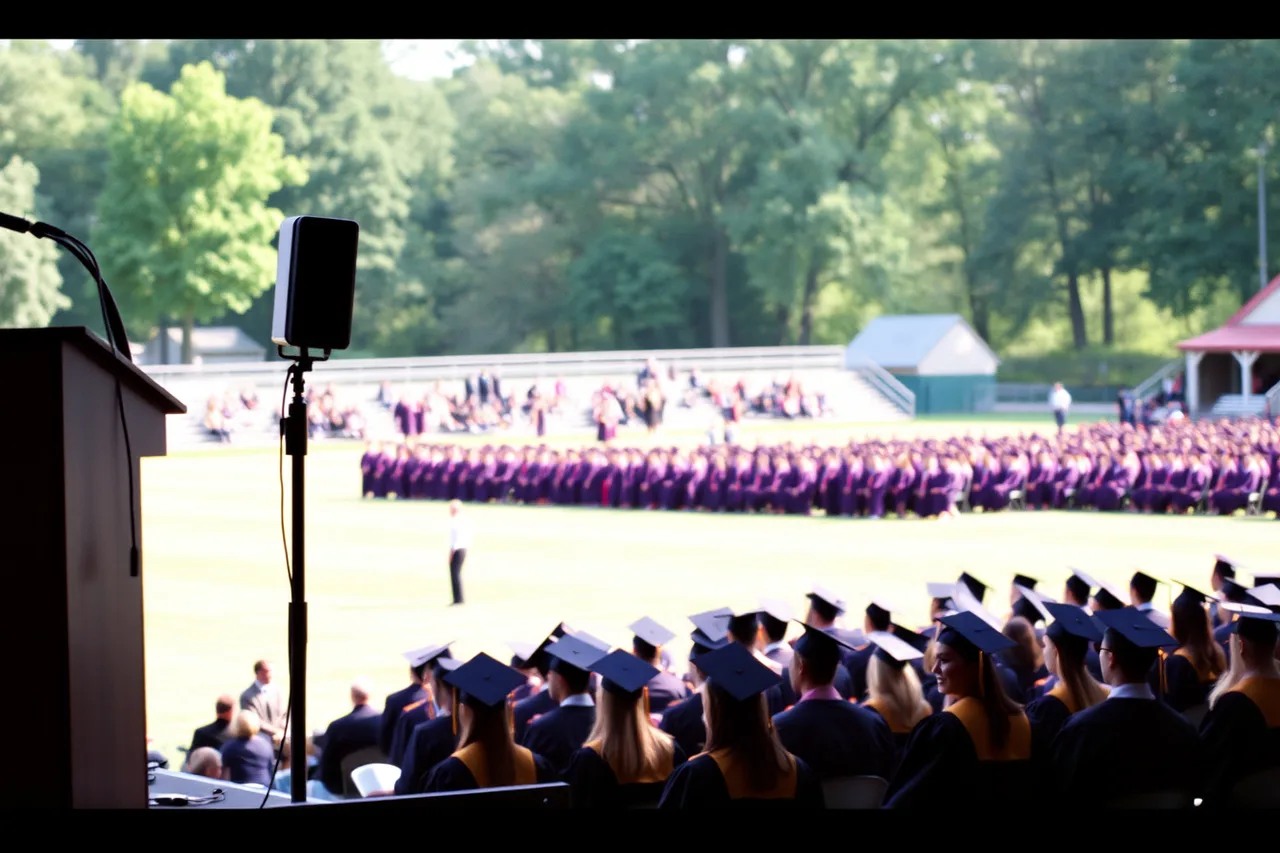
A send-off the crowd can hear coming. In the open air, through a public address system built for reading out names, the audience does not know when a short speech is ending. A slowing, a return to the opening, a direct address. Without one, the applause starts late and the recording captures a silence.
No advice list. Five instructions in four minutes is a lecture. One, delivered with an instance, is a speech.
Who gives the short ones
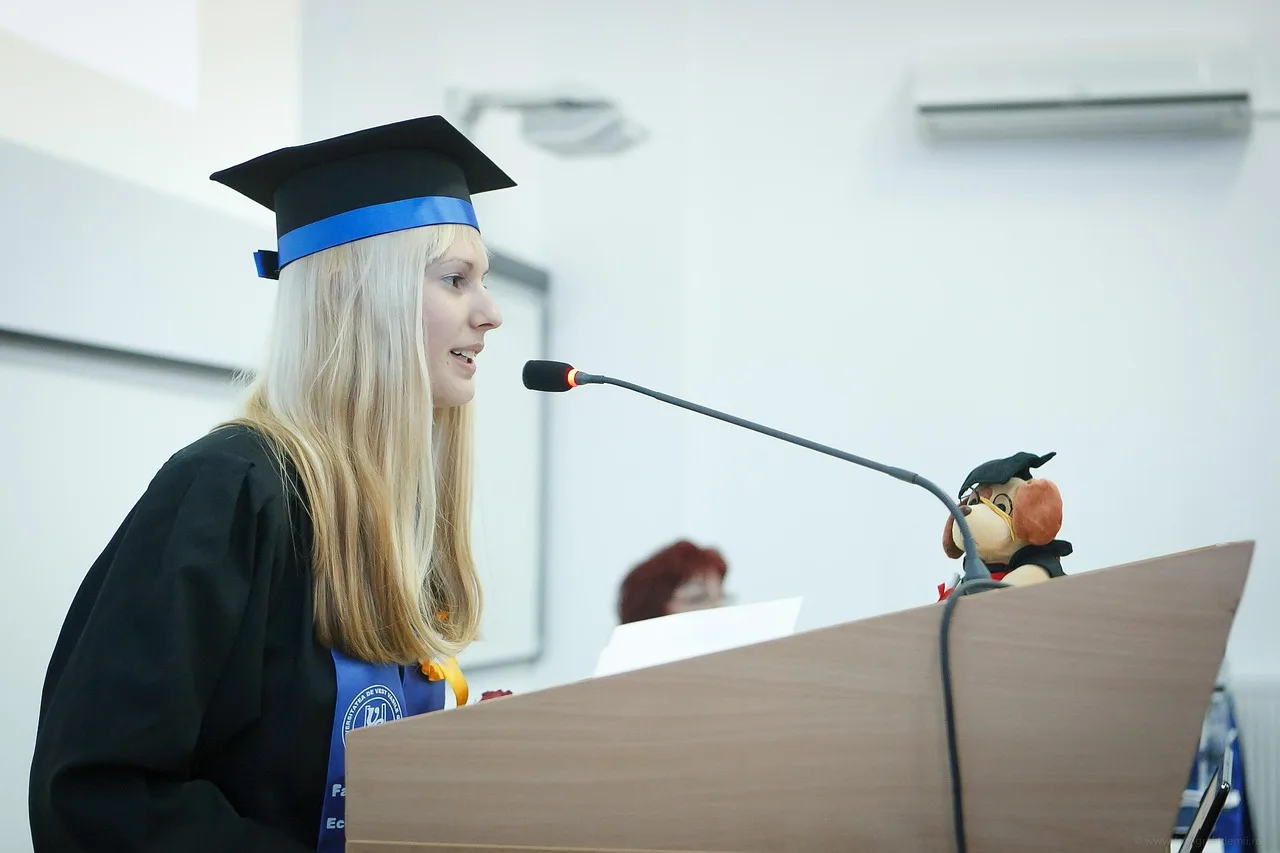
The long address is given by someone whose standing precedes them. The short one is often given by someone whose standing has to be built in the first thirty seconds: a graduate speaking to peers, a teacher speaking to former pupils, a department head the families have never heard of.
That changes the opening. An invited celebrity can start with a joke about themselves. A student speaker cannot, because the audience does not yet know why they should listen.
For a speaker without fame, the reliable opening is a specific shared memory: something that happened to this class, in this place, that graduates recognize and families can picture. It establishes the speaker was there, the only credential available and the only one needed.
The commencement speeches pillar describes the three audiences the form has to serve. A short address by someone from inside the institution usually serves the graduates first and lets the families overhear, the reverse of the invited guest.
Building one
- Write the one-sentence version first. If you cannot, you do not yet have a speech.
- Choose the instance. One event, one place, one group of people, told plainly.
- Open on the instance or on the graduates. Cut every sentence about yourself in the first minute.
- State the idea once, after the instance, in the plainest words you have.
- Return to the opening for the close. A returned phrase tells an outdoor crowd the end is here.
- Time it standing up, out loud, at the pace you will actually speak, which is slower than reading. Then cut a quarter.
- Say it to someone who was not there and ask what you said. If their sentence is not your sentence, rewrite.
A short address is not a long one compressed. The structural habits that make it hearable on a single pass are described in rhetorical devices.
Why quoted lines are unreliable
The program prints the prepared text. Speakers depart from it, especially inexperienced ones, especially outdoors, especially under a strict limit when a page gets skipped to make the time. The program survives and the delivery does not, so the printed line is what gets quoted and it may never have been said.
The institution then posts the prepared text online, tidied. Local references go, the joke that misfired goes, and what remains is a document about what the speaker meant to say, edited by someone else.
The most-circulated American case is "Wear Sunscreen." Mary Schmich wrote it as a Chicago Tribune column in June 1997. It spread as a Kurt Vonnegut commencement speech, which he denied giving, and Baz Luhrmann released it as a hit single in 1999.
Short addresses are rarely recorded properly. When a line from one circulates with quotation marks, ask what it is quoting. Usually the answer is the program.
The ceremony itself is old and its conventions are stable, as the survey of graduation sets out. What is recent is the expectation that the address will be read afterwards by strangers.
Studying the short form
Most of the useful analysis needs no text at all.
- Time to the first substantive sentence.Short addresses range from zero preliminaries to half the slot spent on thanks.
- Count the ideas.More than one is the common failure, and it is countable.
- Find the instance.Is there one, and is it specific to this place?
- Mark the ending signal.Where the audience realized it was over, and how far that was from the last word.
- Compare the program text with the recording,where both exist, and note the gap rather than resolving it.
The speech analysis method covers all of this from a recording. For a form with the same strict slot and the same captive audience, see award speeches.
Common questions
How short is short?
Whatever the running order says, minus a little. The institution's time is the constraint, and a speaker who gives back thirty seconds is remembered more kindly than one who takes thirty extra.
Which commencement speeches are actually short?
Steve Jobs at Stanford in 2005, John Roberts at Cardigan Mountain in 2017 and George Saunders at Syracuse in 2013 come in under about fifteen minutes. J.K. Rowling at Harvard in 2008, David Foster Wallace at Kenyon in 2005 and William McRaven at Texas in 2014 sit near twenty minutes, which is short for a ceremony.
Should a student speaker try to be funny?
One line, about the class and not about a person, if it is genuinely funny to people who were there. A joke that needs explaining to the families costs more than it earns.
Can I quote a famous address in mine?
You can, but under five minutes it spends time you do not have on someone else's idea. If the line is misattributed, which many graduation lines are, you have repeated an error in front of several hundred people.
Where do I check a line before I use it?
Start with the delivering institution's own archive or the Library of Congress, then the broadcaster that covered it. Where the text, the audio and the reported version disagree, cite the primary source and say which one you used.